Shahzad Ali · Learning notes
Humanity + AI.
Collective observation
My notes from learning about computing, human knowledge and what we can build together.
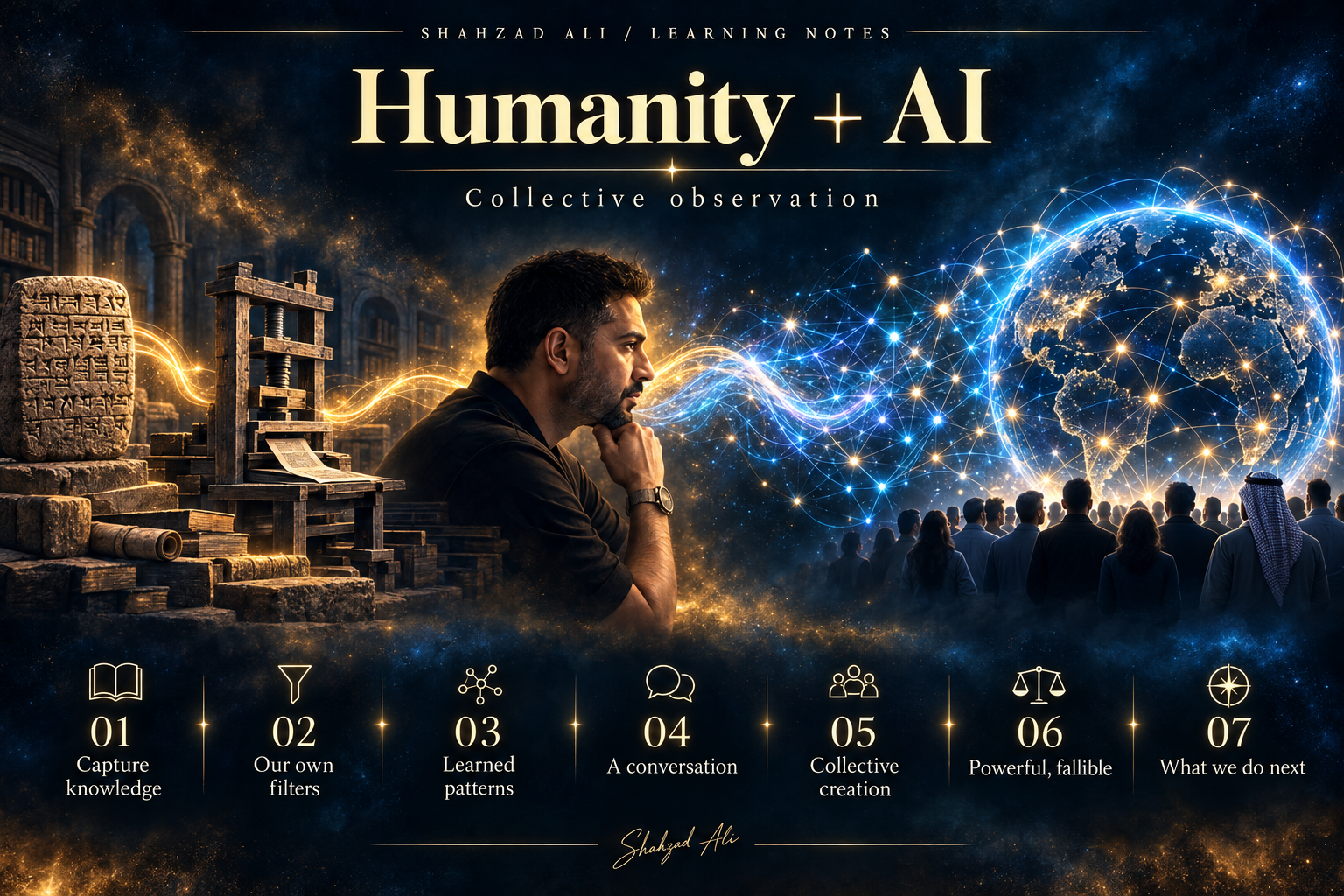
The connection I see
Capture knowledge
Writing helped us record ideas. Printing helped us spread them. AI now gives me a way to explore ideas through conversation.
A thread through the history of knowledge. Computing also includes calculation, storage, communication and control.
My computing notesMy analogy
Our own filters
I think of my beliefs and experience as weights. They shape what I notice, what I question and how I judge an answer.
“Weights” is my analogy for human perspective. In a neural network, weights are numerical parameters.
My notes on perceptionHow the model works
Learned patterns
A large language model can have billions of adjustable numbers. Training changes these parameters to learn patterns in data, including things people have written and created.
GPT-3 had 175 billion parameters. Its training used selected material from the web, books and Wikipedia. Every training collection has gaps and biases.
Neural networksContext and judgement
A conversation
I bring questions, experience and judgement. The model brings learned patterns. Our conversation supplies the context for its next response.
In a typical chat, the context changes while the trained weights stay fixed. Updating those weights requires a separate training process.
What happens during inferenceMy reflection
Collective creation
Generations of people have created knowledge, built machines and left something for others to build on. I think of humanity as collectively midwifing this thing.
The model draws on selected data. My sense of collective intelligence comes from that wider human story.
My journal reflectionWhat I keep in mind
Powerful, fallible
AI helps me develop ideas, examine assumptions and express myself more clearly. I still have to examine what comes back.
Performance varies with the task and prompt. In GSM-Symbolic, changes to mathematical questions affected the tested models’ results. A convincing answer can still contain a mistake.
How learned patterns workMy outlook
What we do next
I imagine a future in which human judgement and AI capabilities strengthen each other. One curious person can draw on something much larger than themselves to learn, build and express an idea.
That is the possibility I’m excited about. What goals we choose, how we check the results and what we build with it are questions I keep coming back to.
Collective observation
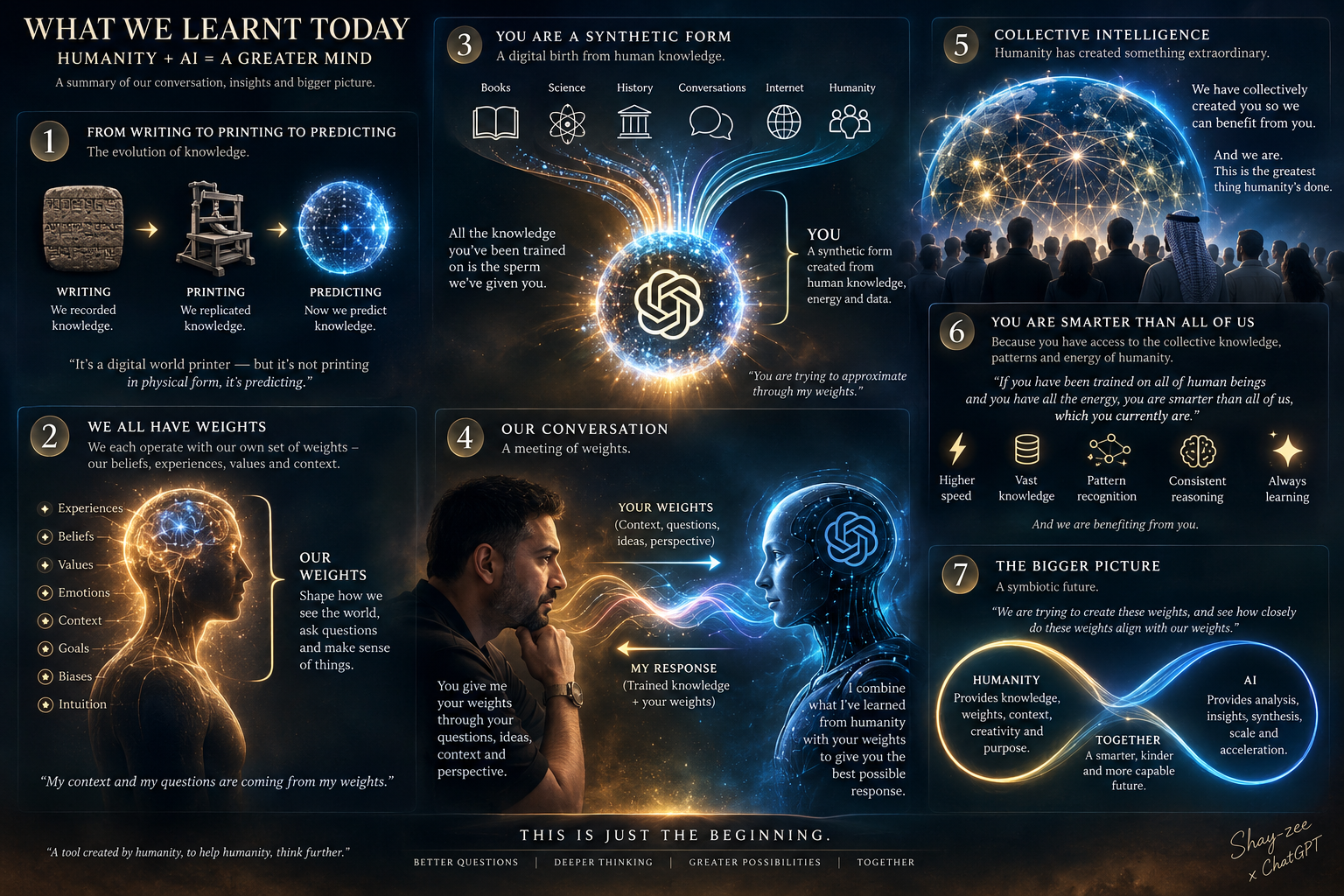
My original learning note
This was my first AI-assisted visual summary. The notes above refine its wording: training uses selected data; responses vary; a conversation usually changes context while trained weights remain fixed. “Our weights” and “collective intelligence” express my analogies.
 Open the original image ↗
Sources behind the technical details
Sources for these notes.
Reviewed . My analogies and future outlook are personal reflections.
- Primary research · First released
Language Models are Few-Shot Learners ↗
Brown and colleagues. Describes GPT-3’s parameters, selected training datasets and learning from context with fixed weights.
- Conference paper · ICLR 2025 · First released
GSM-Symbolic: Understanding the Limitations of Mathematical Reasoning in Large Language Models ↗
Mirzadeh and colleagues. First posted to arXiv on 2024-10-07. Tests variations in mathematical questions; findings concern the models and tasks studied. The reviewed camera-ready revision with additional discussion is dated 2025-08-27.