A free goal workbook
The Philosophy of Success 1
The goal matrix workbook. Understand yourself, choose a goal and turn it into daily action.
The thread through the book
Understand yourself. Choose a direction. Make the next useful action clear. Repeat, review and adjust.
Print it and write.
I encourage you to print this workbook and write your answers by hand. Give yourself time with each page. Write what matters to you, choose one goal and work through it in your own words. Come back each week and write down what happened.
Print the whole book, or start with the seven worksheets on pages 13–18 and 20. Use A4 paper; the goal matrix on page 14 is landscape. You can also type into the blank fields and save your copy.
The worked example follows Sam from one goal through a filled-in matrix, a weekly plan and an honest review. The sample answers are fictional.
A completed worksheet
What a filled-in page looks like.
Sam’s fictional example gives the goal a reason, a deadline, responses to obstacles and four next actions. A blank copy is on page 15.
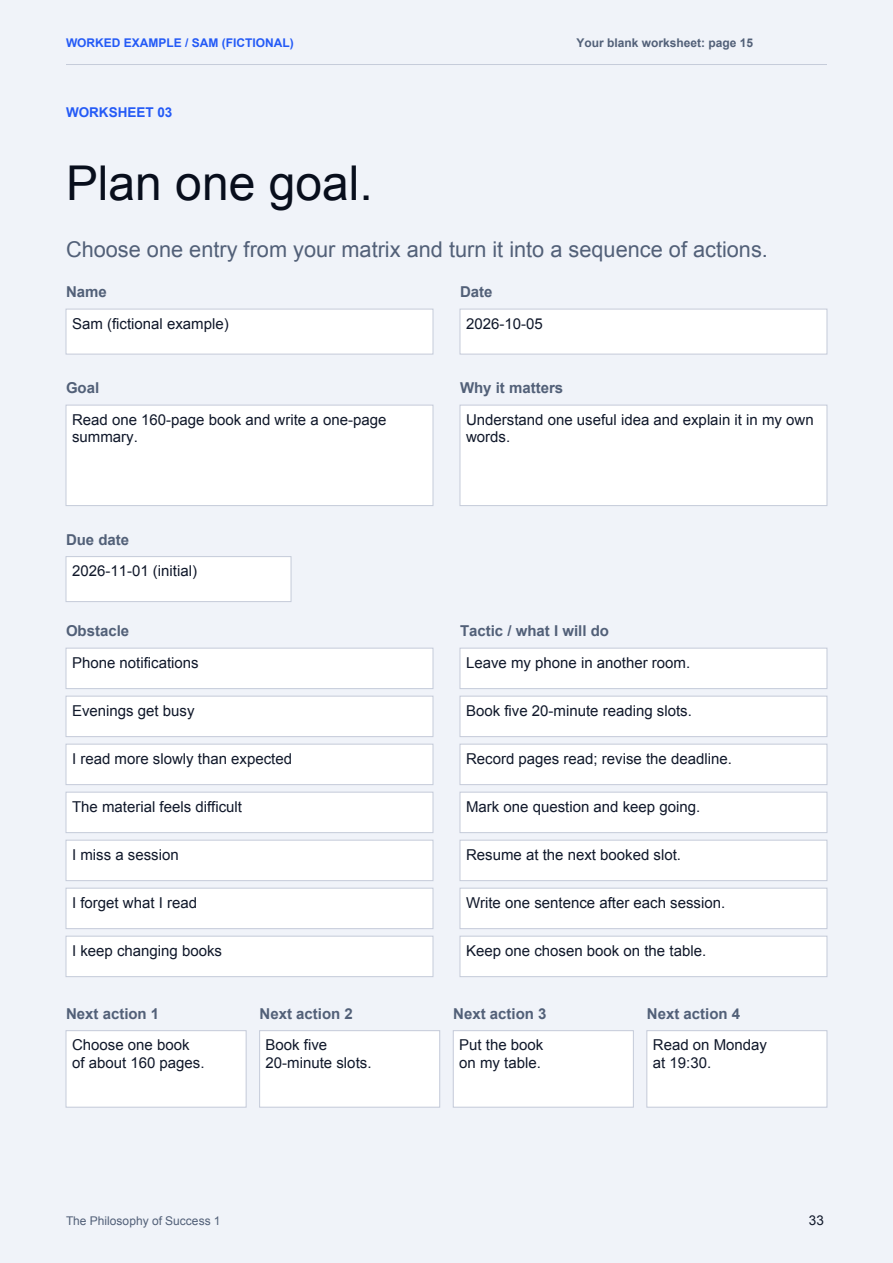
Print the worksheets on pages 13–18 and 20 and write your answers by hand. Worked examples begin on page 30; optional AI help is on page 40. The blank fields also support typing and saving.
Open the filled-in planner in the PDF ↗The journey
From understanding to action.
- 01
Creating value
Understand a need and make something useful.
- 02
Purpose, service and action
Three principles for choosing your direction.
- 03
Goals and distractions
Connect the outcome you want to the actions you take.
- 04
Knowing yourself
Notice your patterns, strengths and surroundings.
- 05
The goal matrix
Bring seven areas of life into one view.
- 06
Planning tools
A goal planner, daily time audit and future-self reflection.
- 07
Small habits
Make an action easier and connect it to an existing routine.
- 08
Notes
Space to think, write and review.
A worked example
One goal, filled in.
Sam wants to read one 160-page book and write a one-page summary. Follow the filled-in answers from reflection to review.
Sam · Fictional example
Notice your starting point
Sam uses recent moments from ordinary life. The three columns describe changing experiences.
- Learning / clarity
- One paragraph made sense.
- Learning / activity
- I opened three books at once.
- Learning / inertia
- I scrolled instead of reading.
Fictional sample answers for this workbook.
Sam · Fictional example
Choose one active goal
Start with the Learning row. The other life areas remain available when they become useful.
- Goal
- Read 160 pages; write a one-page summary.
- Obstacles
- Phone; busy evenings; uncertain pace.
- Skills
- Explain one idea in my own words.
- Habits
- Five 20-minute reading slots each week.
- People
- A friend for a Sunday check-in.
Fictional sample answers for this workbook.
Sam · Fictional example
Plan one goal
Give the goal a reason, a first deadline and actions you can put in a diary.
- Goal
- Read one 160-page book and write a one-page summary.
- Why it matters
- Understand one useful idea and explain it in my own words.
- Start
- 2026-10-05
- Initial due date
- 2026-11-01 (initial)
Fictional sample answers for this workbook.
Sam · Fictional example
Prepare for obstacles
Pair each obstacle with a practical response.
- Phone notifications
- Leave my phone in another room.
- Evenings get busy
- Book five 20-minute reading slots.
- I read more slowly than expected
- Record pages read; revise the deadline.
- The material feels difficult
- Mark one question and keep going.
- I miss a session
- Resume at the next booked slot.
- I forget what I read
- Write one sentence after each session.
- I keep changing books
- Keep one chosen book on the table.
Fictional sample answers for this workbook.
Sam · Fictional example
Write the next four actions
These are the steps Sam can begin this week.
- Action 1
- Choose one book of about 160 pages.
- Action 2
- Book five 20-minute slots.
- Action 3
- Put the book on my table.
- Action 4
- Read on Monday at 19:30.
Fictional sample answers for this workbook.
Sam · Fictional example
Find time in a real day
Sam records a full 24-hour day. One existing 45-minute screen block offers room to test a 20-minute reading slot.
- Observed time
- 19:30-20:15: scroll or watch videos.
- One change
- Use 19:30-19:50 for reading on Monday, Wednesday and Friday. Put the phone away.
Fictional sample answers for this workbook.
Sam · Fictional example
See where your habits lead
Describe the pattern, a possible consequence and one experiment.
- Pattern
- I buy books, then leave reading until I feel ready. My phone is usually beside me. Last week I watched videos during the time I had imagined using for reading.
- Possible direction
- If this continues, I may keep collecting books while finishing few. My reading pace is still unknown. The first week will give me evidence about the time I need.
- Change to try
- Try five booked 20-minute sessions for one week. Put the phone in another room. On Sunday, count sessions and pages, then decide what to change.
Fictional sample answers for this workbook.
Sam · Fictional example
Picture an ordinary future day
Imagine how the goal fits around work, rest and relationships. Treat the date as a plan you can review.
- Chosen date
- 2026-11-01 (initial picture)
- A small step
- Choose the book and book my first five reading slots. Keep the book beside the place where I drink tea.
Fictional sample answers for this workbook.
Sam · Fictional example
Make starting easy
One paragraph is the starting action. Track the longer reading sessions separately.
- After I...
- put my evening tea on the table
- I will...
- open the book and read one paragraph
- Then I celebrate by...
- quietly saying, "I started."
Fictional sample answers for this workbook.
Sam · Fictional example
Put the week in your calendar
Five 20-minute reading slots: Monday, Wednesday and Friday at 19:30; Saturday and Sunday at 09:00. A separate 10-minute review is on Sunday at 09:30.
- Reading time
- 5 x 20 minutes = 100 minutes per week.
- Initial pace estimate
- About 40 pages per week. Check the estimate using actual reading.
- Summary time
- Book a separate 30-minute session after finishing the book.
Fictional sample answers for this workbook.
Sam · Fictional example
Review what actually happened
The first week gives Sam evidence to change the plan.
- 2026-10-11 review
- Completed 3 of 5 sessions; read 24 of the estimated 40 pages.
- What happened
- Work ran late on Wednesday. I accepted another commitment during Friday's booked slot.
- Change
- Move Wednesday and Friday to 07:15, after breakfast. Start those mornings at 06:40 to leave time before the 07:45 journey. Put the book out the night before. Ask a friend to check in on Sunday.
- Revised estimate
- 136 pages remain. At the observed 24 pages per week, allow six more weeks to finish reading by 2026-11-22.
- Revised goal deadline
- 2026-11-29, including a separate 30-minute summary session. Review the estimate each Sunday.
Fictional sample answers for this workbook.
A thinking partner
Optional help from AI.
Use AI if you want help thinking through a question. Then put the answer into your own words on paper.
- Open your AI assistant. Attach the workbook if it supports files, or use this prompt on its own.
- Copy and paste the prompt below. Review the draft, then write your answers in your own words on the printed pages.
Read the prompt
Choose which personal details you share. The same prompt is on page 40 of the workbook.
Blank worksheets and labelled worked examples sit in the same book. Save a copy for your answers. Source credits appear below and in the PDF.
Sources and credits
An updated edition of my original workbook. Models and ideas are credited to their sources below and in the PDF.
- Howard Stevenson and Harvard Business School ↗
The entrepreneurship definition draws on Stevenson's account of pursuing opportunity beyond the resources currently under your control.
- Nir Eyal, Indistractable ↗
The distinction between traction and distraction, and between internal and external triggers.
- Steven Pressfield, The War of Art ↗
Resistance as a way to describe the avoidance that can stand between an intention and the work.
- Bhagavad Gita 2.47 ↗
A philosophical teaching about action and attachment to its results. The linked edition contains Swami Mukundananda's translation and commentary.
- Bhagavad Gita, chapter 14 ↗
The three gunas are a traditional framework in Hindu philosophy. The workbook uses clarity, activity and inertia as plain-language prompts for reflection.
- BJ Fogg, Fogg Behaviour Model ↗
B=MAP: motivation, ability and a prompt come together for an action to occur.
- BJ Fogg, Tiny Habits ↗
Making a new action small and connecting it to an existing routine. The habit recipe also includes a brief celebration.
- Berkeley Personality Lab, the Big Five ↗
A research framework describing broad patterns in personality: openness, conscientiousness, extraversion, agreeableness and neuroticism.
- Kathy Kolbe, Kolbe A Index ↗
The provider describes this commercial assessment as a way to explore instinctive approaches to taking action.